
Azure Functions vs ASP.NET Core Web API: Which Architecture Fits Your Next API?
AZ Functions vs Web API

High‑traffic enterprise platform or lightweight microservice? Choosing between Azure Functions (serverless) and a traditional ASP.NET Core REST Web API will define your costs, scalability, developer experience, and even your DevOps pipeline. This guide breaks down when to use Azure Functions and when a classic Web API makes more sense, with a clear, search‑friendly breakdown of pros, cons, and real‑world scenarios.
What Are Azure Functions?
Azure Functions is Microsoft’s serverless compute service. Each “function” is a tiny, event‑driven unit of code that scales automatically and bills by the millisecond. For HTTP‑triggered workloads it effectively acts as a miniature Web API—ideal for:
Webhooks
Glue logic between SaaS apps
Light CRUD endpoints
👉 Sweet spot: ≤ 3 tightly‑coupled entities per Function App.
What Is ASP.NET Core Web API?
ASP.NET Core Web API is the full‑framework, always‑on REST service many teams already deploy on Azure App Service, AKS, or VMs. It supports:
Rich middleware pipelines
Versioning, OData, Swagger
Centralized authentication & domain‑driven design
👉 Sweet spot: complex APIs with 4+ aggregates, multiple versions, and strict latency requirements.
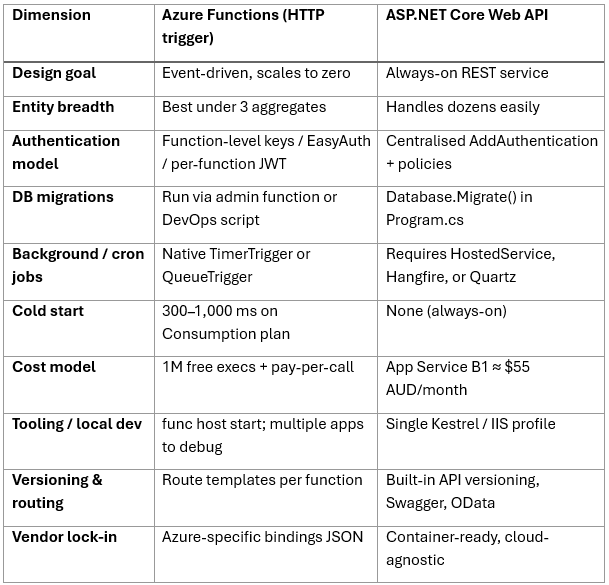
Side‑by‑Side Comparison
Cost & Cold‑Start Implications
Serverless savings: A low‑traffic API (< 1 req/s) may run entirely in Azure’s free tier (1 M executions + 400 k GB‑s).
Cold starts: If P95 latency below 500 ms is mandatory, either move to a Premium Function Plan or stick with Web API.
Authentication, Migration, & Shared Services
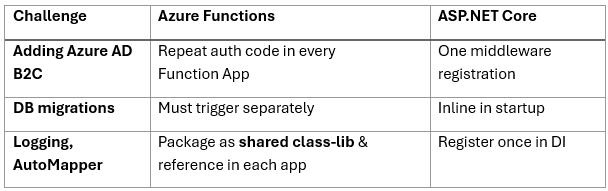
Bottom line: the more cross‑cutting concerns you have, the more friction you’ll feel in pure serverless.
Best‑Fit Use Cases
When Azure Functions Shine
Micro‑APIs for quote calculators, password‑reset links, webhook receivers
Apps with long idle periods but spiky bursts
Built‑in cron jobs (TimerTrigger) or queue consumers in the same Consumption Plan
When ASP.NET Core Is Better
Line‑of‑business APIs with Orders, Products, Payments, Reporting
Strict SLAs (no cold starts)
Heavy use of middleware, Swagger documentation, or API versioning
Decision Checklist
✅ < 1 req/s average traffic? → Functions
✅ > 3 aggregates & complex relationships? → Web API
✅ Need native cron/queue triggers? → Functions
✅ Portable to any Kubernetes cluster? → Web API
✅ Budget‑sensitive MVP? → Functions’ free tier
Key Takeaways
Scope matters: Azure Functions excel for micro‑services, while ASP.NET Core scales across domain‑rich APIs.
Cost vs latency: Consumption plan is cheapest but adds cold‑start delay. Premium Functions or Web API remove that pain.
Shared concerns: Centralizing auth, migrations, and logging is far easier in a monolithic Web API.
Hybrid wins: Many teams host their core REST service in ASP.NET Core and off‑load scheduled jobs or webhook handlers to Azure Functions for zero‑cost scaling.
Use this guide to architect the right backend for your next project, balancing serverless savings against enterprise‑grade maintainability.